The measurements cited in this briefing are from the pre-correction data epoch (before 1 June 2026), which carries a +3 dB systematic bias in absolute SPL terms. See the calibration history for the full record.
The relative measurements that this briefing's argument actually rests on — the 27.7 dB above-background delta and the Recovery Deficit Index (54 of 58 disrupted intervals) — are unaffected by the calibration correction. Both are defined relative to the session's own background level, so the offset cancels mathematically. The absolute peak SPL value (70.2 dBA) should be read as approximately 3 dB high; the corrected value is ~67.2 dBA. The disruption pattern described in this briefing stands independent of the absolute calibration adjustment.
What 70.2 dBA actually sounds like
Sound levels in dBA are not intuitive. The decibel scale is logarithmic — every 10 dB increase represents roughly a doubling of perceived loudness. These reference points translate the measurement into everyday experience:
This aircraft, at the bedroom window, was as loud as having a vacuum cleaner running right next to the bed. It was not a distant hum. It was a foreground sound.
The psychoacoustic measurement — perceived loudness in sones — peaked at 21. The sone scale is built so that doubling means twice as loud to a person. A score of 21 sones is roughly fifteen to twenty times louder than ordinary conversation. The phon measurement of 84 corresponds to the level at which two people in the same room have to stop talking and wait for the noise to pass before continuing — speech becomes unintelligible without raising voices significantly.
How loud relative to the normal acoustic environment
The measurement that matters most is not the peak level in isolation — it is how far that peak is above the location's normal background. The baseline acoustic floor at this location is 42.5 dBA (LA90 — the level exceeded 90% of the time, which approximates the true background). That is a properly quiet residential environment: birds, the occasional distant car, an HVAC fan cycling on.
The aircraft peak was 70.2 dBA — 27.7 dB above the normal background. Every 10 dB is roughly a doubling of perceived loudness. This aircraft was perceived as approximately six to seven times louder than the quiet morning it interrupted.
It was not a marginal increase. It was a categorical change in the soundscape — a foreground industrial sound dropped into what is otherwise a quiet residential morning. No amount of habituation eliminates the physiological response to that kind of intrusion. The body responds whether or not the mind has learned to expect it.
Sleep disturbance — why 6:55 AM matters
The time of day matters enormously in noise health research. 6:55 AM falls within the World Health Organization's defined night and early morning sensitivity window, when the human body is most vulnerable to noise-induced harm. What does 70.2 dBA at the bedroom window actually mean for someone sleeping inside?
The pattern matters more than any single event
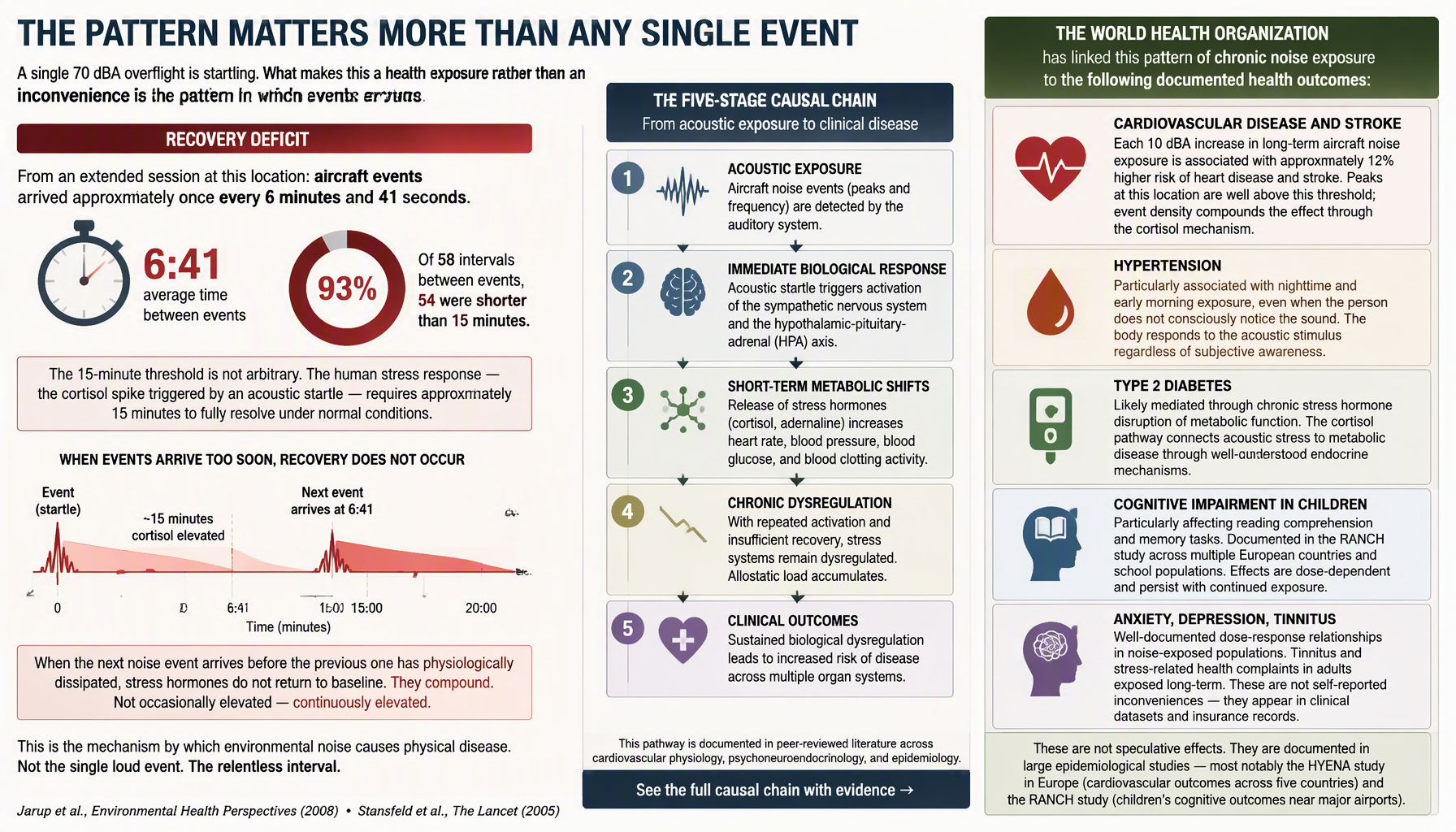
A single 70 dBA overflight is startling. What makes this a health exposure rather than an inconvenience is the pattern in which events arrive.
From an extended session at this location: aircraft events arrived approximately once every 6 minutes and 41 seconds. Of 58 intervals between events, 54 were shorter than 15 minutes.
Open full size · Download infographic (PNG)
The 15-minute threshold is not arbitrary. The human stress response — the cortisol spike triggered by an acoustic startle — requires approximately 15 minutes to fully resolve under normal conditions. When the next noise event arrives before the previous one has physiologically dissipated, stress hormones do not return to baseline. They compound. Not occasionally elevated — continuously elevated.
This is the mechanism by which environmental noise causes physical disease. Not the single loud event. The relentless interval.
The five-stage causal chain — from acoustic exposure through immediate biological response, short-term metabolic shifts, chronic dysregulation, and ultimately to clinical outcomes — is documented in peer-reviewed literature across cardiovascular physiology, psychoneuroendocrinology, and epidemiology. See the full causal chain with evidence →
The World Health Organization has linked this pattern of chronic noise exposure to the following documented health outcomes:
These are not speculative effects. They are documented in large epidemiological studies — most notably the HYENA study in Europe (cardiovascular outcomes across five countries) and the RANCH study (children's cognitive outcomes near major airports). Jarup et al., Environmental Health Perspectives (2008) · Stansfeld et al., The Lancet (2005)
What this data can and cannot say
Intellectual honesty requires stating what the evidence supports and what it does not.
- The acoustic exposure at this location meets the conditions WHO has linked to the health endpoints above
- The intrusion magnitude — 27.7 dB above background — is large enough to cause acute startle responses and sleep disruption
- The event density (9.1 per hour, 54 of 58 intervals under the stress-recovery threshold) is in the range associated with chronic stress mechanisms
- The measurement system is calibrated against an AZ8930-verified Class 2 reference meter and validated across multiple aircraft types, flight phases, and two independent operating points — all within IEC 61672 Class 2 tolerance
- That any specific person at this address has developed a specific disease because of these aircraft
- That long-term outcomes will follow the same dose-response curves observed in European studies — those populations differ
- That health effects scale linearly from a small dataset
Health outcomes are statistical at the population level, not deterministic at the individual level. What has been measured is the dose. The disease outcomes are probabilistic. The science does not say "this person will develop heart disease" — it says "people exposed to this much aircraft noise, on average, develop cardiovascular disease at measurably higher rates."
From the numbers to the human stakes
The parent whose afternoon in the backyard with his children is interrupted every seven minutes is not imagining things. The interruption is real, the noise is loud, and the cumulative pattern of those interruptions — repeated daily for years — falls within the range of exposure that established medical evidence links to cardiovascular and cognitive harm. The science does not say he will develop heart disease. It says people exposed to this much aircraft noise, on average, do so at measurably higher rates.
The person jarred awake at 6:55 AM is not being sensitive. The noise reached the WHO threshold for sleep disturbance inside a closed bedroom. The body responded whether or not consciousness registered the event.
This is a residential location experiencing an exposure pattern that public health authorities have linked to documented harms. It is not an inconvenience. It is a population-scale health exposure. And it is measurable, characterizable, and now documented.
TrueNoise exists to make that documentation possible at community scale — with calibrated instruments, rigorous methodology, and transparent data — so that the conversation with regulators can move from "residents are complaining" to "here is what the evidence shows."